FinOps (Financial Operations) is a discipline that brings together business, finance, and IT to manage cloud costs effectively. Key practices: establish cross-functional teams, implement cost monitoring, adopt cost awareness culture, optimize spend with reserved instances/savings plans, and iterate continuously.
Introduction
FinOps is the discipline of treating cloud spend the way you'd treat any other operational metric: visible, owned by named teams, and actively managed. The name is a bit business-school, but the practice is mostly common-sense engineering hygiene applied to billing.
This post covers what FinOps is in practice, why it tends to fail without cross-functional buy-in, and the handful of practices that make it stick: cost monitoring, consistent tagging, savings plans, and regular reviews.
What is FinOps?
FinOps, or Financial Operations, is an evolving cloud financial management discipline that brings together business, finance, and IT to enable teams to move faster, spend smarter, and understand the ROI of cloud spending more deeply. At its heart, FinOps is about enhancing financial control without compromising on agility or performance.
FinOps encompasses practices that help organizations forecast, monitor, and manage cloud expenses in a proactive and efficient manner - not just reactive cost cutting.
Why is FinOps Important?
As organizations migrate more services to the cloud, managing costs becomes increasingly complex. Cloud billing is dynamic, with costs fluctuating based on demand, usage, and services utilized. Without a disciplined approach, businesses risk overspending or stifling innovation due to financial constraints.
FinOps plays a key role by:
- Improving Cost Visibility - Real-time insights into cloud spending for informed decisions
- Promoting Collaboration - Bridges the gap between finance, IT, and business units
- Enhancing Decision Making - Detailed metrics and benchmarks for optimizing investments
Best Practices for Implementing FinOps
- Establish a Cross-Functional FinOps Team - A dedicated team from finance, IT, and business units drives the initiative with a full approach
- Implement Cloud Cost Monitoring and Reporting - Use cloud cost management tools to track spending in real-time and set alerts for budget overruns
- Adopt a Culture of Cost Awareness - Encourage stakeholders to consider financial implications of cloud usage, use tagging for cost allocation
- Optimize Cloud Usage and Spend - Regularly review and adjust resources, use reserved instances or savings plans
- Iterate and Improve - Continuously refine practices based on new insights and changing business needs
Start with resource tagging. Consistent tagging of all cloud resources enables accurate cost allocation, chargebacks, and identifies optimization opportunities by team, project, or environment.
The Benefits of FinOps
- Cost Efficiency - Avoid unnecessary spending and allocate resources more effectively
- Greater Agility - Financial insights integrated into decision-making enable faster innovation and adaptation
- Enhanced Transparency - Cloud spending is fully visible and understandable to all stakeholders
FinOps is not about cutting costs at all costs. It's about making informed trade-offs between speed, cost, and quality to maximize business value from cloud investments.
Troubleshooting FinOps Implementation
- No visibility into costs - Enable Cost Explorer, set up AWS Budgets, and implement consistent tagging. Consider third-party tools for multi-cloud environments.
- Teams resistant to cost awareness - Show teams how cost visibility helps them (more budget for innovation). Make cost data accessible and actionable, not punitive.
- Unexpected cost spikes - Set up billing alerts and anomaly detection. Review Cost Explorer regularly. Check for runaway resources like forgotten dev environments.
- Savings plans underutilized - Analyze usage patterns over 30+ days before committing. Start conservative and increase coverage as usage stabilizes.
- Tagging inconsistency - Implement tag policies, use AWS Organizations Tag Policies to enforce standards, and automate tagging with Lambda or Config rules.
- Siloed cost responsibility - Create shared dashboards, hold regular FinOps reviews, and tie cost optimization to team goals.
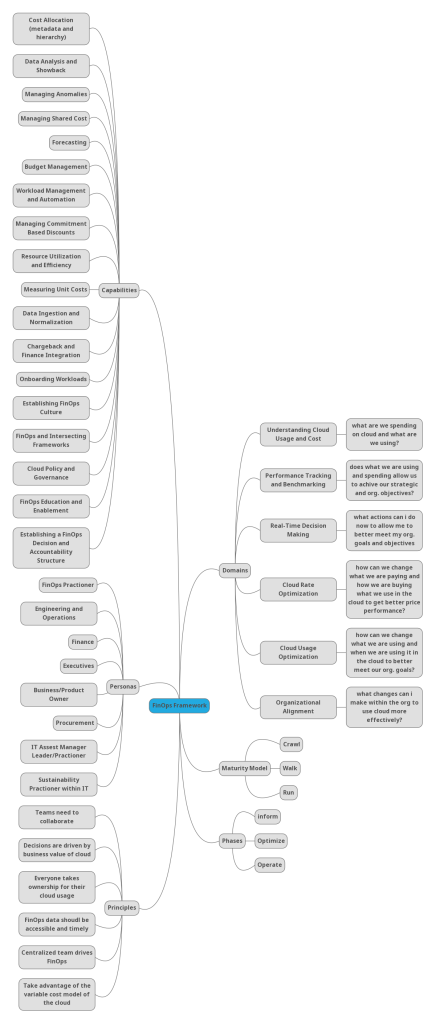
FinOps Framework MindMap
Want Help With This?
If you're working on something similar and want a second set of eyes, or you'd like to talk through how this applies to your environment, reach out via the contact form. Happy to help.